Avoid a False £6,500 Green Light: Make Open to Buy Work in Retail

TL;DR:
- Using retail versus cost basis in OTB calculations can cause overestimations of available buy amount by 40 to 60 percent, leading to overcommitment.
- Neglecting to subtract receipts on order or mixing measurement bases is the most common mistake that causes OTB figures to be inaccurate.
- Monthly recalculations of OTB suit stable categories, while weekly reviews are necessary for fast-moving or promotional groups to keep plans aligned with reality.
- Implementing category-level OTB enables more precise buying decisions by highlighting which product groups need attention or reallocation.
- Partnering with suppliers like Mailady that allow smaller, frequent orders and real-time order tracking helps maintain accurate on-order data and better OTB discipline.
Table of Contents
- What is open to buy in retail, and why does it matter?
- How do you calculate OTB step by step?
- How should retailers build OTB into a planning process?
- Should you calculate OTB by department, category or channel?
- What mistakes cause OTB figures to drift from reality?
- When does OTB tracking need software instead of a spreadsheet?
- Keeping on-order records accurate with a flexible supplier
- Why OTB discipline takes longer to embed than the formula suggests
- Where Mailady fits into a live OTB workflow
- Sources
- FAQ
What is open to buy in retail, and why does it matter?
Open-to-buy (OTB) is a budgeting tool that helps determine the amount you can spend on new stock without overcommitting your cash. It acts as a spending ceiling rather than a target. Shopify describes it as an inventory budgeting strategy that calculates what a retailer can afford to purchase during a set period, after subtracting what's already on hand and already on order. That distinction between a ceiling and a target is where most retailers trip up. Buyers treat OTB as a figure to spend, when its actual job is to stop you spending more than the business can absorb.
The standard OTB formula, used across apparel, home goods and most general retail, is:
OTB = Planned sales + Planned markdowns + Planned end-of-period inventory − Beginning-of-period inventory − Receipts on order
Each term does specific work:
- Planned sales is the revenue you expect to generate in the period, at your chosen valuation basis.
- Planned markdowns covers stock you expect to discount, whether for clearance, promotions or seasonal transitions.
- Planned end-of-period inventory is the stock level you want sitting on shelves or in the stockroom when the period closes.
- Beginning-of-period inventory is what you're already holding when the period starts.
- Receipts on order is everything already ordered but not yet delivered.
The formula only works if every input uses the same measurement basis. RetailNorthstar's formula guide is explicit on this: all figures must be at either retail value or cost value, never mixed. Retail basis suits merchandising teams aligning OTB to a broader financial plan. Cost basis suits anyone whose main concern is cash flow, because it reflects what you actually pay suppliers rather than the marked-up sale price.
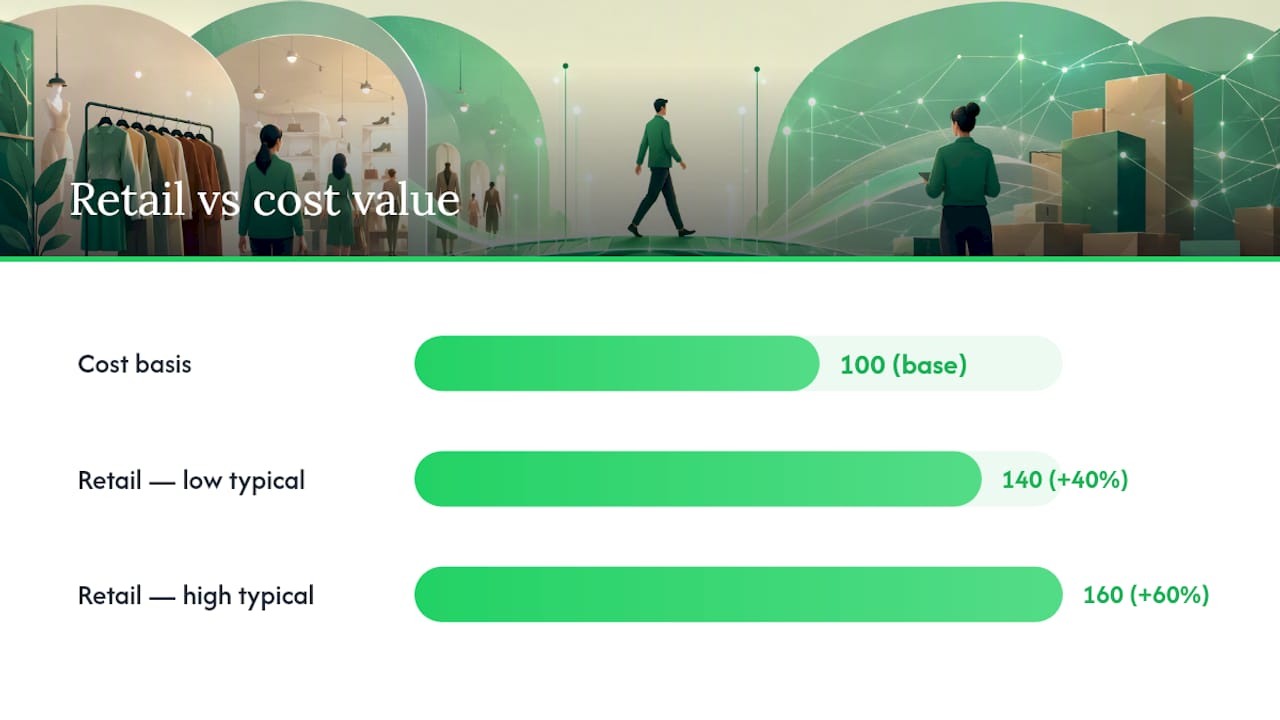
Why the basis choice trips people up: mixing retail and cost values in one calculation doesn't just introduce a small rounding error. It can flip a positive OTB into a false green light when the real position is already negative, because retail values typically run 40 to 60% higher than cost for the same goods.
How do you calculate OTB step by step?
Numbers make this concrete faster than definitions do. Take a mid-sized apparel category with the following figures for a one-month period, all measured at cost:
- Planned sales: £18,000
- Planned markdowns: £1,500 (end-of-season clearance on slow lines)
- Planned end-of-period inventory: £22,000 (enough stock to cover roughly four weeks of forward sales)
- Beginning-of-period inventory: £26,000 (what's currently on the floor and in the stockroom)
- Receipts on order: £9,000 (purchase orders already placed but not yet delivered)
Plug those into the formula to calculate your OTB, which shows the remaining budget available for new purchase orders this month without breaching the inventory plan. If the same calculation had returned a negative number, say minus £3,000, that would mean your existing stock and open orders already exceed what the plan supports. The correct response isn't to place a smaller order anyway. RetailNorthstar notes that a negative OTB signals over-commitment and calls for cancelling open orders, delaying shipments, or reforecasting sales and markdown assumptions rather than pushing ahead with new buys.
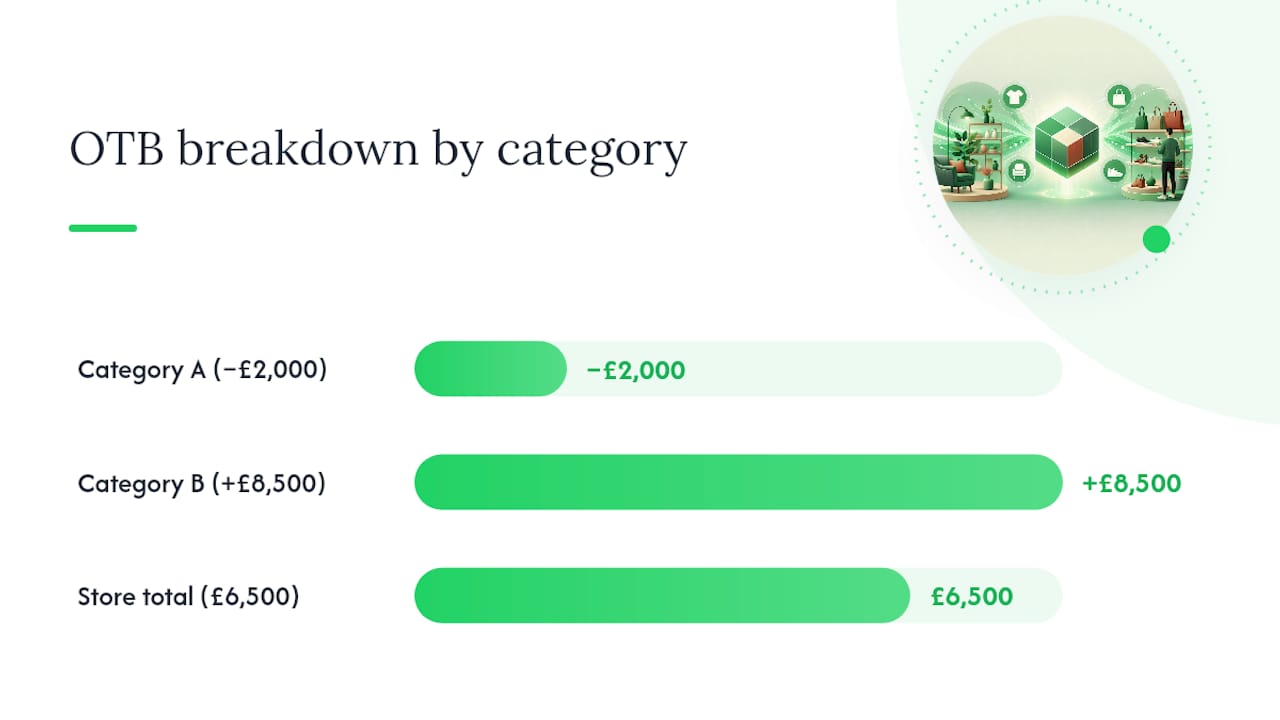
A zero result sits in between: you're precisely on plan, with no room to add stock until sales move inventory down or a receipt gets pushed out. Pro Tip: Run the calculation at the category level before you total it up store-wide. A store-wide OTB of £6,500 can hide one category sitting at minus £2,000 and another at plus £8,500, and you'd never know which one needed attention.
How should retailers build OTB into a planning process?
OTB only earns its keep as part of a repeatable sequence, not a one-off spreadsheet exercise. The standard build order runs like this:
- Set the sales budget for the period, by category, based on last year's performance plus known trend shifts.
- Apply expected margins and planned markdowns, since these determine how much of that sales figure survives as usable cash.
- Set the target end-of-period inventory, usually expressed as weeks of supply appropriate to the category.
- Confirm beginning-of-period inventory from your actual stock count, not an estimate.
- Pull receipts on order, meaning every open purchase order not yet delivered.
- Compute OTB and translate the result into buying decisions: place new orders, delay a shipment, cancel a PO, or reallocate budget to a stronger category.
Cadence is where a lot of the value gets left on the table. A monthly recalculation is a reasonable baseline for stable categories like basics or home textiles. Fast-moving fashion categories need weekly review, because a single strong sales week or a delayed delivery can swing the number meaningfully. Categories with volatile demand, new launches, or heavy promotional activity often warrant a two-week check. RetailNorthstar's guidance points to recalculating whenever a sale books, a PO cancels, a markdown gets taken, or a receipt date shifts, since each of those events changes the inputs and lets the plan drift from reality if left unchecked.
Pro Tip: Set a recurring calendar reminder tied to your PO cycle, not just the calendar month. If your supplier ships every two weeks, recalculate OTB on that same rhythm so buying decisions and delivery timing stay aligned.
Should you calculate OTB by department, category or channel?
A single blended OTB figure for the whole store hides more than it reveals. One category running hot on sell-through can offset another sitting on ageing stock, and a buyer working from the combined number has no way to see which lines actually need attention. KoronaPOS makes the case that category-level OTB is more useful than a store-wide figure precisely because planned markdowns and target ending inventory vary so much between product groups, seasonal fashion needs a different markdown assumption than staple basics or towels.
Splitting a total OTB budget across categories works best when it's grounded in data rather than gut feel:
- Allocate by historical sales mix, giving each category a share of the buying budget proportional to its contribution to revenue.
- Adjust using sell-through rate, so categories moving stock faster than planned get first claim on additional OTB.
- Set a reorder priority rule, typically restocking proven performers before testing new lines.
- Flag slow movers early and shift their allocated OTB elsewhere rather than leaving cash tied up in stock that isn't turning.
This kind of breakdown gives buyers room to reinvest in what's working and react to a trend before the season ends, rather than discovering the shift in a post-mortem report. That flexibility, allocating by department or class instead of guessing store-wide, is one of the more underused levers in retail buying.
What mistakes cause OTB figures to drift from reality?
The most common failure isn't a formula error. It's leaving something out. Manual OTB calculations most often omit receipts on order, the purchase orders already placed but not yet delivered, which overstates how much buying capacity actually exists. If you've got £9,000 in open POs and forget to subtract them, your OTB looks £9,000 healthier than it is.
Other recurring problems:
- Mixing retail and cost values within one calculation, which distorts the result even when every individual number is correct.
- Treating OTB as a static figure, calculated once at the start of a season and never revisited even as sales, receipts and markdowns move.
- Skipping reconciliation between what the PO system shows and what's actually been received, which lets on-order figures go stale.
Pro Tip: When OTB turns negative, don't quietly ignore it and place the order anyway. Cancel or push back the least critical open PO first, then recalculate, rather than letting the gap compound into next period.
When does OTB tracking need software instead of a spreadsheet?
A spreadsheet works fine for smaller operations, provided two disciplines hold: accurate on-order records and a fixed recalculation cadence you actually stick to. Shopify's guidance on OTB planning notes that larger retailers benefit more from dedicated planning tools, because live data reduces the drift that creeps into manually updated sheets.
Features worth prioritising once you outgrow spreadsheets:
- Live recalculation whenever a sale posts or a PO status changes, rather than waiting for a manual refresh.
- On-order reconciliation that matches purchase orders against actual receipts automatically.
- Department and category breakouts built in by default, not bolted on as a separate tab.
- Alerts that flag when OTB crosses zero, so nobody finds out three weeks late.
- Multi-channel reporting if you sell through more than one storefront or marketplace.
For a two-person buying team running a handful of categories, a well-built spreadsheet with strict update habits will get you most of the way there.
Keeping on-order records accurate with a flexible supplier
On-order omission is the single biggest source of OTB error, and the fix starts upstream, with how orders get placed in the first place. A supplier that restocks styles seasonally, like Mailady, lets retailers place smaller, more frequent orders instead of one large seasonal commitment that sits as an open PO for months.
That matters for OTB accuracy in a direct way:
- Smaller, frequent receipts are easier to log and reconcile than one large delayed shipment.
- Direct WhatsApp ordering creates a running written record of what's been ordered and when, which makes updating your on-order line straightforward.
- No minimum order requirement means you can top up a category exactly when OTB shows room, rather than over-ordering to hit a supplier's threshold.
Coordinating your PO cadence with a supplier that ships this way keeps the "receipts on order" input in your OTB formula closer to what's actually true at any given moment.
Why OTB discipline takes longer to embed than the formula suggests
The maths behind open-to-buy is straightforward. Getting a buying team to actually use it week after week is the harder part. It usually takes a season or two before sales, finance and buying are pulling from the same numbers instead of three separate spreadsheets. Start with a monthly cadence at store level, get the habit right, then push down to category-level and tighter update cycles once the basics stick. Trying to run a perfect five-category weekly OTB from day one is how most retailers abandon the practice within a month.
Abhishek Sanghvi
Where Mailady fits into a live OTB workflow
Keeping OTB accurate depends on how fast your on-order records reflect reality, and that's largely a function of who you buy from. Some wholesale suppliers offer styles restocked seasonally across a wide range of colours, which means you're not locked into one enormous order that sits open for months and quietly inflates your receipts-on-order figure.
Ordering direct through WhatsApp keeps a running, timestamped record of what's been placed and when, so reconciling on-order against actual receipts can be efficient. Some suppliers have no minimum order threshold, allowing you to top up a category the moment your OTB calculation shows room, instead of over-buying to hit a quota. If you're rebuilding your buying cadence around a live OTB number, start by browsing the current collections to confirm what's in stock and check lead times before you log your next purchase order.
Sources
Frequently asked questions
What does "open-to-buy" mean in retail?
Open-to-buy is the amount you can still spend on new stock for a period after subtracting current inventory and everything already on order. It works as a spending ceiling, not a target to hit.
How do you calculate OTB in retail?
Use the formula: OTB = planned sales + planned markdowns + planned end-of-period inventory − beginning-of-period inventory − receipts on order, keeping every figure at either cost or retail value, never both.
What is an example of OTB?
In a category with £18,000 planned sales, £1,500 planned markdowns, £22,000 target ending inventory, £26,000 starting inventory and £9,000 in open orders, OTB comes to £6,500 available for new purchases.
What happens when OTB is negative?
A negative OTB means existing stock and open orders already exceed the plan, so the correct response is to cancel or delay purchase orders and reforecast rather than place new buys.
How often should retailers recalculate OTB?
Monthly works as a baseline for stable categories, but fast-moving fashion lines typically need weekly recalculation, and volatile or promotional categories often warrant a two-week check.
Buying for your store this season?
More guides
- 5 Fabric Pilling Test Methods for Lab Technicians and When to Use EachA fabric pilling test measures how readily a textile forms those small fuzzy balls on its surface after rubbing or abrasion. The main method families are the Martindale test, random tumble (ICI/pilling box), brush pilling, elastomeric pad, and circular locus, each governed by an ASTM or ISO standard. Which one you choose depends entirely on the fabric's end use, from knitwear to upholstery.
- MOQ, sets and catalogues: how minimum orders really work in Indian wholesaleMost MOQ advice online is written for American boutiques buying from American vendors. Here is how minimums are actually counted when you buy ladies wear in India, and what each way of counting does to your cash.
- How to choose a wholesale clothing supplier in India: 12 questions before your first orderAnyone can send you a good photo and a low rate. These are the twelve questions that tell you whether a supplier will still be worth buying from on your fourth order.